
Drivers hand-selected
ScanSpeak Revelator tweeters, Seas midrange, Purifi or Focal woofers selected for linearity within 0.0001% tolerance. Each pair of loudspeakers receives hand-matched drivers. No automatic catalogue picking.
Atelier · Castelvetrano · Sicily
The build process of an Ars Aures speaker is not a catalogue line. It is the brand's most rigorous document. Fifteen working stages to the final finishing, up to ten weeks on the Estasi Evo cabinet, crossover rigorously hand-assembled under the loupe. Below, all told for those who want to be part of a story — not for those who want to be convinced.
On this page
Chapter one
The first-order crossover is a design choice, not a commercial one. It sacrifices a little efficiency and imposes strict constraints on driver selection — drivers chosen for their characteristics and their ability to serve our sound philosophy; but it is the only topology that allows temporal phase coherence between the frequencies. For those who play the piano — seven octaves, microsecond attack — this is not a detail: it is the difference between recognising a note in its innermost essence and merely hearing it.
ScanSpeak Revelator tweeters, Seas midrange, Purifi or Focal woofers selected for linearity within 0.0001% tolerance. Each pair of loudspeakers receives hand-matched drivers. No automatic catalogue picking.
Strict selection and measurement of the voice coils and capacitors that will make up the crossover, which is wholly hand-assembled, one week of final tuning on the measurement bench. Component tolerances at 0.5%. Non-inductive resistors, pure-copper litz coils, capacitors to A.A. specifications.
Point-to-point internal wiring, WBT or Deep Audio binding posts, always in pure copper or special alloys. Never silver. No PCB, no intermediate connectors. The signal touches only audiograde materials.
Chapter two
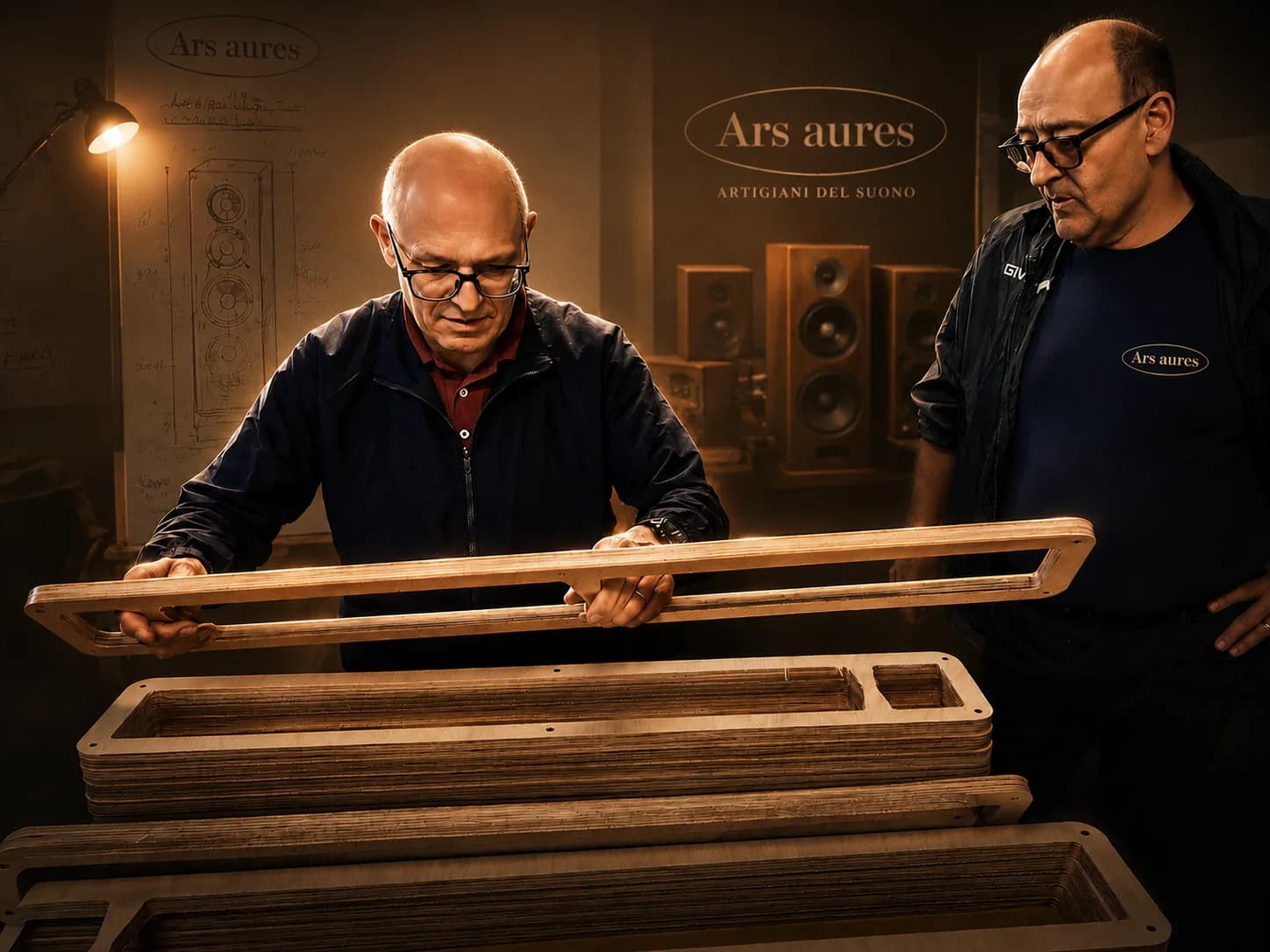
A Midi Sensorial Mk III cabinet is not a simple box. It is a variable-thickness wall structure — 30 to 60 mm — calibrated on the resonance modes of the internal cavity. Manual work per pair, from the smallest to the flagship, in our temperature- and humidity-controlled woodshop. Awaiting Next. Awaiting the next sonic revolution.
Non-parallel walls to avoid standing waves. Heavy bracing at multiple points for structural rigidity. The Mk II and Mk III models have a dual-cavity transmission line (like the Estasi and its forerunner the Sol). Everything is modelled in finite elements before going into the woodshop.
European plywood from a supplier across the Alps — poplar for the internal modules, birch for the external panels. Minimum six months seasoning in a controlled environment before cutting. CNC cutting on a Biesse Rover 24 with ±0.1 mm tolerance and on a 4-axis Bienne 300 Plus.
For the Midi Sensorial Mk III: four weeks of cabinet work per pair, from first roughing to final assembly jig. Physical verification of the finite-element simulation, not iteration on prototypes.
Chapter three
Fifteen working stages to the final coating — the same adopted for Stradivari violins, the same used by Lamborghini and Aston Martin. Two-component acrylic varnishes, manual spray application, oven curing at controlled temperature, hand polishing.
Piano Black, White Glossy, Designo Mocha, Iroko and Rovere solid wood, Ferrari Red, Deep Blue, Red Wine. Every catalogue finish is available on any model. Plus unlimited colour customisation.
The same two-component acrylic varnishes used by the highest-end carmakers. A deep shine that shifts with ambient light — exactly as on Stradivari violins.
The fifteen stages require 72 hours of rest between colour and clear — there is no way to speed it up. The final polishing is entirely manual: every panel passes twice under the finisher's hand.
The fifteen stages
Progressive sanding of cabinet surfaces, internal sealer application, first intermediate sanding. Raking-light inspection to expose micro-defects in the wood.
Four hand-sprayed acrylic base coats. Oven curing between coats. Intermediate sanding every two coats.
Six coats of final colour (the hue of the chosen finish — Designo Mocha, White Glossy, etc.). 72 hours of rest after the last coat, before the clear.
Two coats of two-component acrylic clear. Full curing in a temperature-controlled oven. The surface stabilises before polishing.
Hand polishing. Each panel passes twice under the polisher's hand: once for the primary polish, once for the final pass.
The Castelvetrano atelier is open by appointment. A day among the varnishing lab, the woodshop, the crossover bench, and the listening room. For clients, distributors, journalists, collectors.